
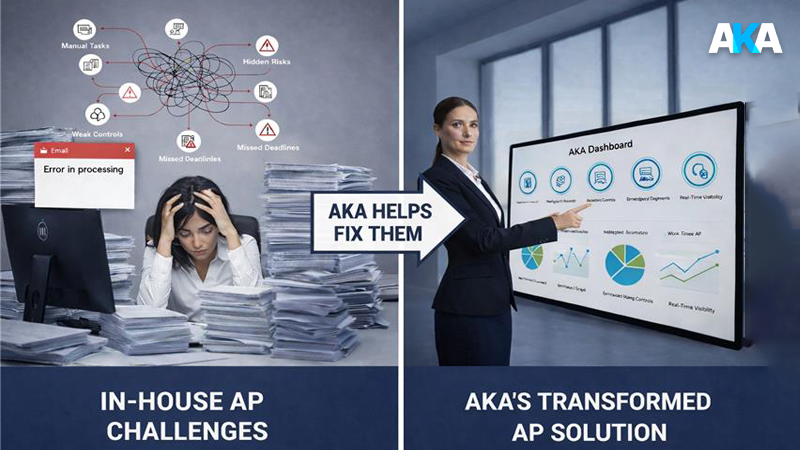
Common Challenges in in-house Accounts Payable Management and How Aka Helps Fix Them
Accounts Payable problems rarely announce themselves.
Invoices get processed. Payments go out. Vendors stay reasonably calm.
So AP feels “under control.”
But beneath the surface, many in-house AP
teams are struggling with manual work, weak controls, and limited
visibility—issues that quietly drain cash and create audit risk.
This is exactly where AKA steps in.
Where In-House AP Starts to Break Down
As businesses grow, AP complexity grows
faster than processes.
Teams deal with:
- Multiple invoice formats and intake channels
- Manual validations and approvals
- Frequent exceptions and vendor follow-ups
- Pressure to reduce costs and protect cash
Without structure, AP becomes reactive.
Problems are fixed after they happen—not prevented.
AKA’s approach focuses on redesigning AP,
not just running it.
How AKA Transforms Accounts Payable
1. Workflow-Driven AP, Not Email-Driven
AP
AKA replaces fragmented, email-based
processing with end-to-end, workflow-driven AP.
Every invoice follows a defined path—from
receipt to validation, approval, posting, and payment.
Nothing is dependent on memory or individuals.
Result:
- Faster invoice turnaround
- Clear ownership at every stage
- Complete transparency and audit trails
2. Automation That Removes Friction, Not
Control
Using accounts payable automation
and finance automation, AKA eliminates repetitive manual work while
strengthening controls.
Automation is applied to:
- Invoice capture and validation
- Matching and exception identification
- Approval routing and escalations
Result:
- Reduced manual errors
- Shorter invoice life cycles
- Higher processing accuracy
This is not automation for speed alone—it’s
automation with governance.
3. Controls Embedded Into Daily
Processing
As an organization with strong audit
firm services, AKA brings a risk and control mindset into AP operations.
Controls are built directly into the
workflow:
- Duplicate invoice detection
- Exception-based transaction reviews
- Segregation of duties
- Continuous monitoring
Result:
- Reduced payment leakages
- Strong audit readiness
- Issues caught early, not during audits
4. Centralized Vendor Management That
Actually Works
Vendor queries and disputes consume a
disproportionate amount of AP time.
AKA sets up a centralized vendor
helpdesk and structured reconciliation process, ensuring:
- Faster response to vendor queries
- Quicker dispute resolution
- Clear communication and accountability
Result:
- Improved vendor relationships
- Fewer escalations
- Less pressure on internal teams
5. Visibility That Supports Better Cash
Decisions
AKA doesn’t just process invoices—it
delivers insight.
Through dashboards and analytics, finance
teams gain:
- Real-time visibility into payables
- Exception and backlog trends
- Vendor-wise exposure analysis
This directly strengthens cash flow
management, enabling better planning and control.
What Changes When AKA Runs AP
Organizations partnering with AKA typically
experience:
- Faster invoice processing and approvals
- Lower cost per invoice
- Reduced dependency on individuals
- Stronger compliance and audit confidence
- Predictable, controlled cash outflows
Most importantly, finance teams stop
firefighting and start focusing on analysis, control, and strategic
priorities.
Final Thought
In-house Accounts Payable doesn’t usually
fail outright.
It weakens slowly—through manual effort,
hidden risks, and poor visibility.
AKA helps organizations fix AP at the root
by combining accounts payable outsourcing, intelligent invoice
processing solutions, and governance-led automation.
The result isn’t just a better AP
process—it’s a stronger, more resilient finance function.
Ready to Strengthen Your Accounts
Payable?
If your AP team is working harder than it should,
it’s time for a smarter model.
Let’s talk about how AKA can help you regain control, clarity, and confidence
in Accounts Payable.