
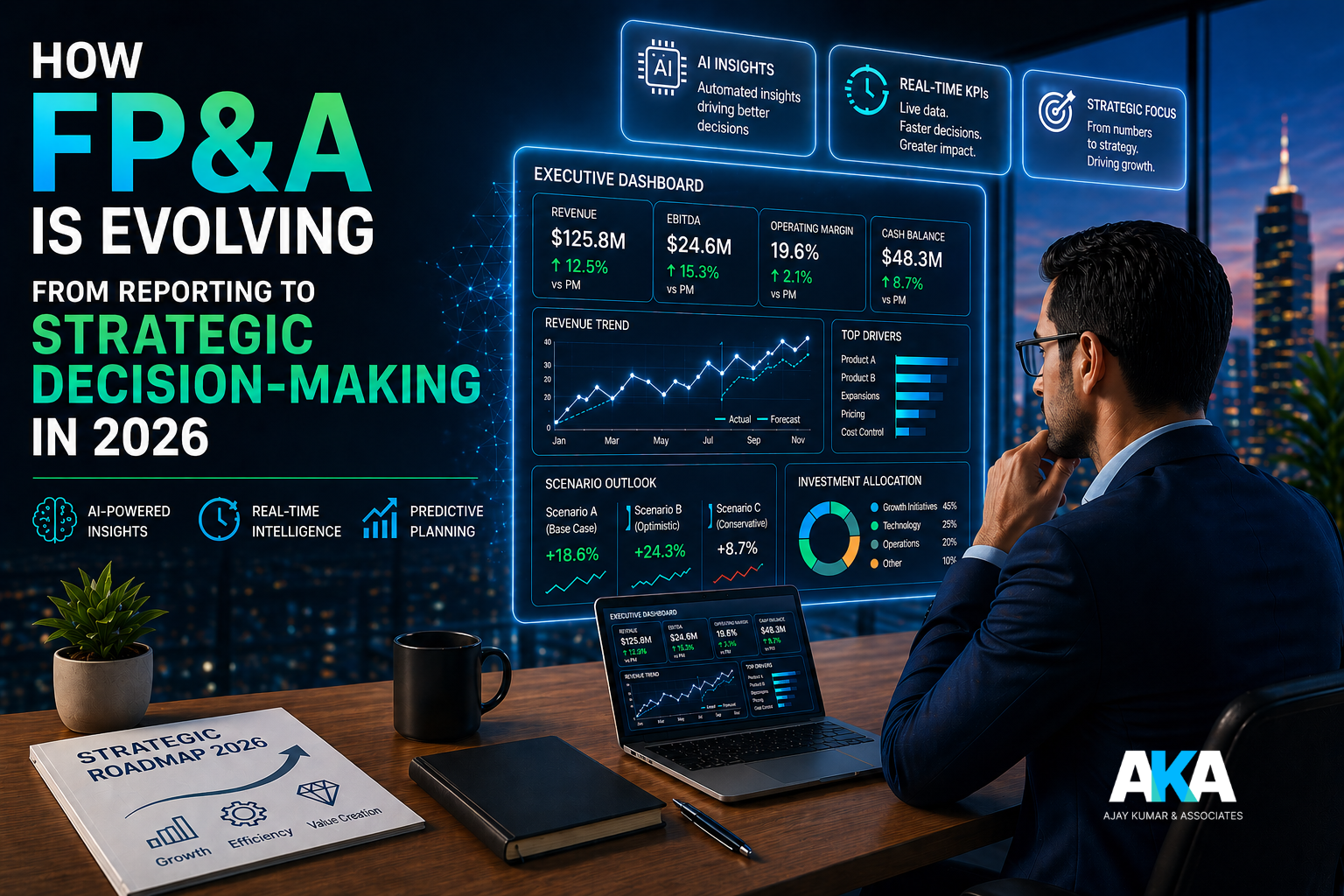
How FP&A Is Evolving from Reporting to Strategic Decision-making in 2026
Financial Planning and Analysis (FP&A) has moved far beyond its traditional role of reporting historical numbers in current changing business landscape. In 2026, organizations expect finance teams to become strategic partners that guide business decisions, improve forecasting accuracy, and enable faster responses to market changes.
At Ajaykumar
and Associates (AKA), we are seeing a clear shift where businesses no
longer rely on FP&A only for monthly reports and budget variance analysis.
Instead, they expect finance teams to deliver real-time insights, predictive
forecasts, and scenario-based decision support.
This
transformation is redefining the future of finance.
The Traditional Role of FP&A
Traditionally,
FP&A was primarily focused on:
- preparing monthly MIS
reports
- analyzing actual vs budget
performance
- variance reporting
- annual budgeting
- historical trend analysis
While
these functions remain essential, they are mostly backward-looking.
In other
words, they explain:
what
happened
But in
2026, leadership teams need answers to:
what will
happen next and what should we do about it?
This is
where strategic FP&A becomes critical.
The Shift from Reporting to Decision Support
Modern
businesses operate in an environment shaped by:
- market volatility
- inflationary pressures
- supply chain disruptions
- digital transformation
- evolving customer demand
In such
conditions, static financial reports are no longer enough.
CFOs now
expect FP&A teams to actively support:
- pricing decisions
- expansion strategies
- investment prioritization
- cost optimization
- working capital planning
This
means FP&A has become a decision intelligence function rather than
just a reporting team.
Real-Time Forecasting Is Replacing Static Budgets
One of
the biggest changes in 2026 is the move away from annual static budgets.
Traditional
budgets often become outdated within a few months due to market shifts.
Businesses
are now adopting:
- rolling forecasts
- quarterly re-forecasting
- scenario planning
- dynamic budgeting
For example,
if raw material costs increase suddenly, finance teams must immediately assess
the impact on profitability and cash flow.
This
agility allows leadership to make timely decisions instead of waiting for
month-end reports.
AI and Automation Are Reshaping FP&A
AI is one
of the most important drivers of FP&A transformation in 2026.
Modern
FP&A functions now use AI for:
- predictive forecasting
- automated variance analysis
- anomaly detection
- cash flow predictions
- dashboard insights
This
reduces manual spreadsheet dependency and improves forecast accuracy.
Instead
of spending hours consolidating Excel sheets, finance teams can focus on business
strategy and advisory support.
Cross-Functional Collaboration Is Becoming
Essential
Another
major evolution is the integration of FP&A with other departments.
Finance
teams are now working closely with:
- sales
- procurement
- HR
- operations
- supply chain
For
example, sales forecasts directly impact:
- revenue planning
- manpower budgeting
- inventory levels
- cash flow requirements
This
integrated approach helps businesses align operational and financial goals.
FP&A
is no longer isolated within finance—it is becoming the central planning
function of the business.
Business Storytelling and Visualization Matter More
Than Ever
In 2026,
finance leaders expect more than spreadsheets.
They
need:
- executive dashboards
- KPI visualization
- business storytelling
- actionable recommendations
A good
FP&A function should not just present numbers.
It should
explain:
- what changed
- why it changed
- what action is required
This is
where dashboards using tools like Tableau and Microsoft Power BI become highly
valuable.
Clear
visual insights significantly improve decision speed and quality.
Why This Matters for Business Growth
The
evolution of FP&A directly impacts business performance.
Strategic
FP&A helps organizations:
- improve profitability
- optimize costs
- strengthen cash flow
- reduce decision latency
- identify growth
opportunities
Businesses
that modernize FP&A gain a competitive advantage because they can make
decisions faster and with greater confidence.
How AKA Supports Modern FP&A Transformation
At Ajaykumar
and Associates (AKA), our FP&A consulting services help
businesses move from traditional reporting to strategic finance transformation.
Our
services include:
- budgeting and forecasting
- rolling financial models
- KPI dashboards
- cash flow forecasting
- automation and reporting
analytics
- management MIS and board
reporting
We help
finance teams become strategic business partners.
In 2026,
FP&A is no longer just about reporting past performance.
It is
about shaping the future of the business.
Organizations
that embrace real-time forecasting, AI-driven analytics, and integrated
planning will be better positioned to navigate uncertainty and drive
sustainable growth.
The
future of finance belongs to businesses that transform FP&A into a
strategic decision-making engine. Get In Touch