
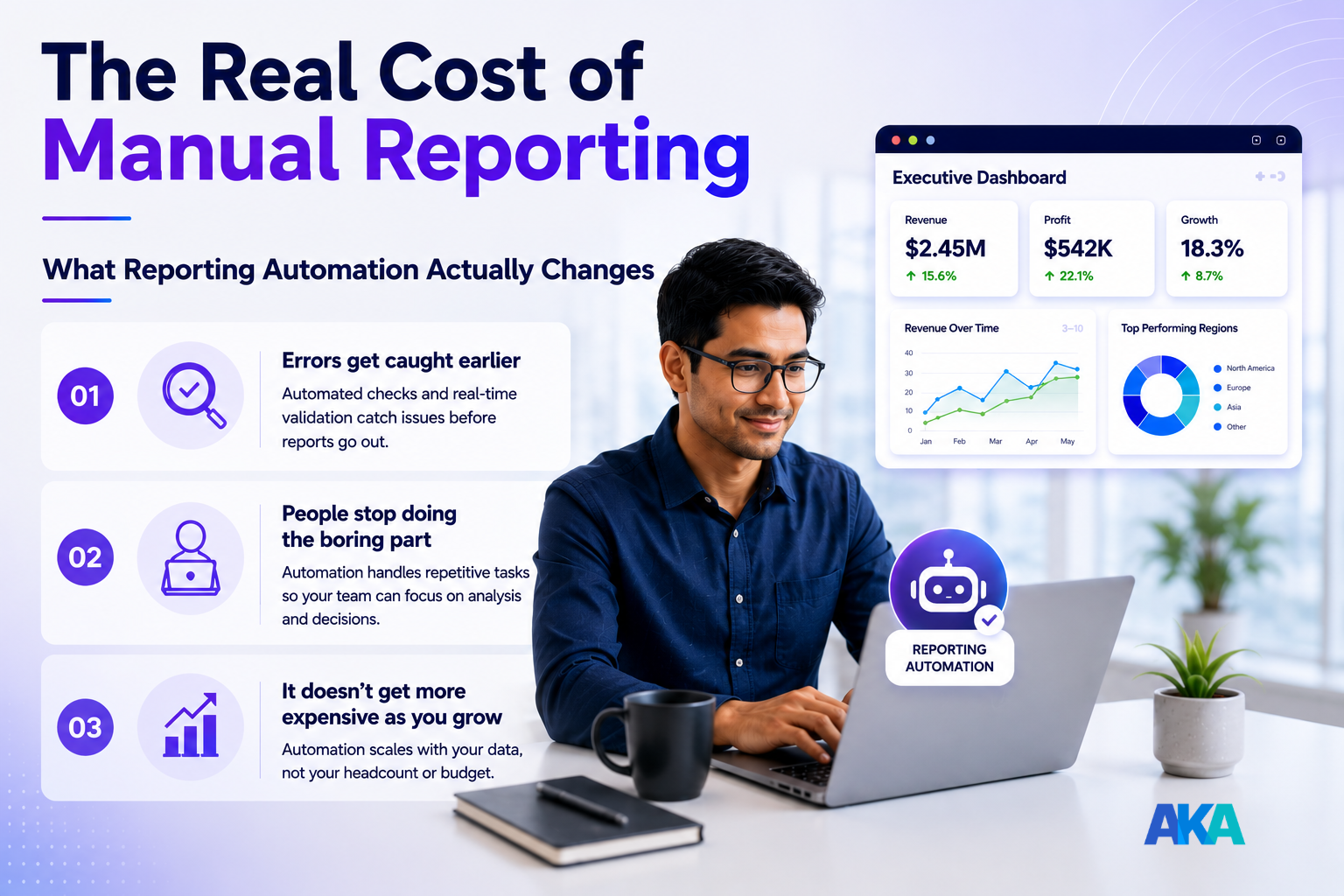
The Real Cost of Manual Reporting (And What Reporting Automation Actually Fixes)
Someone pastes last month's numbers into this month's report by mistake.
Nobody notices until the leadership review. A number looks off. Three people spend the next two hours tracing it back through five spreadsheets.
By the time they find the error, the meeting has moved on. So has the decision that depended on that report.
This isn't a one-off. It's a Tuesday at
most companies still running reports through spreadsheets and manual handoffs.
These kinds of manual reporting challenges
are far more common than most businesses realise.
"1% error rate" sounds small.
It isn't.
Manual data entry runs at 1–4% error rates
even with experienced staff. During busy periods, that can spike dramatically.
Now scale that up. A mid-size AP team
processing 5,000 invoices a month generates tens of thousands of data points.
At just a 1% error rate on 60,000 invoices a year, that's hundreds of errors
and thousands of dollars spent simply correcting them.
And that's before the ripple effects.
A miskeyed PO number triggers a payment
mismatch. A wrong GL code quietly distorts a financial report. The typo itself
is cheap. What it touches on through your systems is not.
Zoom out further and the numbers get
bigger. Gartner puts the average annual cost of poor data quality at $12.9
million per organisation. IBM found over a quarter of companies lose more than
$5 million a year because of it.
None of this shows up as one dramatic
failure.
It just quietly drains the business.
The Hidden Cost Nobody Budgets For:
Decision Lag
Here's the part most conversations around
financial reporting automation skip.
It's not just about errors.
It's about how long it takes someone to
find out something happened.
An overtime trend crosses budget two weeks
before anyone notices. A turnover pattern builds for a month before it shows up
in a report. Every day of that delay has a cost—even though no invoice ever
gets cut for it.
The real win with business reporting
automation isn't fewer typos.
It's shrinking the gap between something
happening and someone seeing it.
What Reporting Automation Actually
Changes
Not just "less manual work."
Three real shifts.
• Errors get caught earlier. Good automated
reporting solutions validate data as it enters—cross-checking figures, flagging
outliers, and identifying inconsistencies—instead of catching mistakes weeks
later during a review.
• People stop doing the boring part. The
goal isn't zero human involvement. It's freeing analysts from re-keying
invoices and updating spreadsheets so they can focus on the few cases that
actually need judgment. This is where reporting automation tools deliver the
biggest operational gains.
• It doesn't get more expensive as you
grow. Manual reporting scales with headcount—more clients, more spreadsheets,
more people needed just to keep up. Business intelligence solutions and
automated reporting systems don't carry that same tax.
Why This Matters More in 2026
If you're RBI- or SEBI-regulated, the bar
just moved.
RBI's CIMS reporting system—built on the
XBRL standard—became mandatory in August 2025 for key returns.
A reporting error here isn't just an
internal headache anymore.
It's potentially a regulatory finding
waiting to happen.
This is exactly why compliance reporting
automation is becoming a business requirement rather than an IT initiative.
Where to Actually Start
• Pick your highest-volume workflow
first—usually AP, AR, payroll, or financial reporting.
• Automate validation before generation—catching bad data early matters more
than producing reports faster.
• Build the audit trail in, not on top.
• Free up your best people—if skilled analysts are still reconciling
spreadsheets at month-end, automation hasn't reached where it should.
Visibility Is the Real Outcome
Most companies don't need more reports.
They need better visibility.
This is where Power BI dashboards, data
analytics services, and practical business intelligence solutions make the
difference.
Real-time dashboards, automated KPI tracking,
and exception reporting mean management teams don't have to wait until
month-end to understand what's happening in the business.
They can see it while there's still time to
act.
Where Ajaykumar & Associates Fits In
We don't sell a full platform overhaul
nobody asked for.
We find the one or two workflows actually
costing you time, money, or audit risk—and fix those first.
That's looked like:
• Business Reporting Automation
• Financial Reporting Automation
• Power BI Dashboard Development
• Business Intelligence Solutions
• Data Analytics Services
• Compliance Reporting Automation
• Reconciliation automation and reporting process redesign.
If reporting errors or compliance gaps are
costing your team more than they should, let's talk about where the real fix
is.