
Why Automated Vendor Reconciliation Is No Longer Optional for Retail, FMCG & Modern Trade
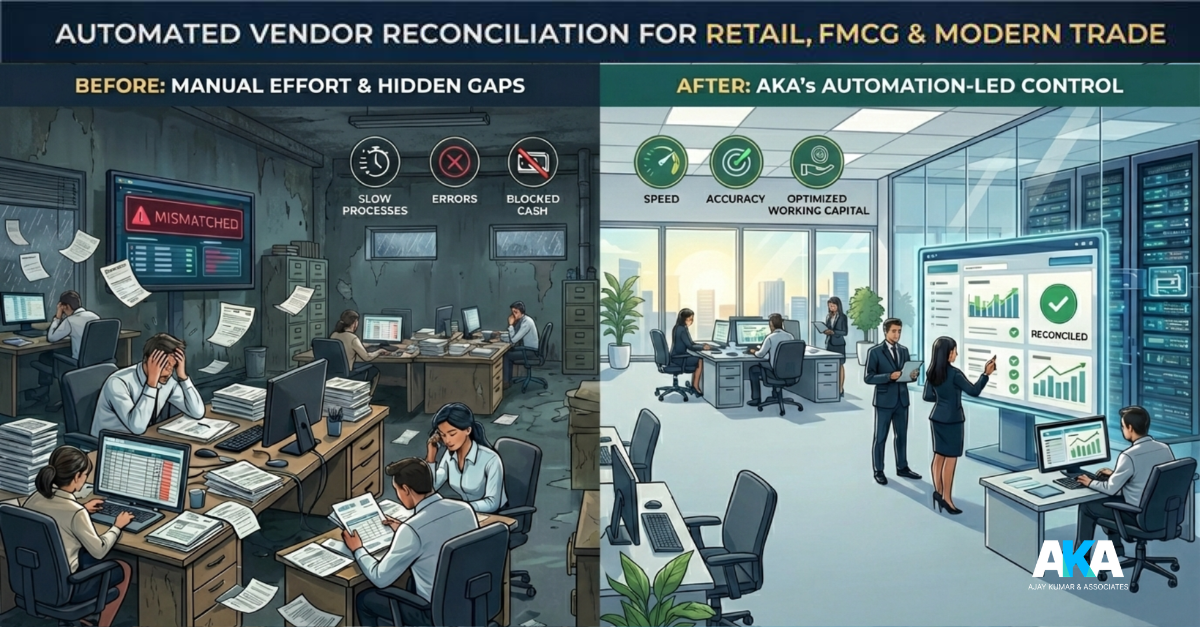
Vendor reconciliation often runs quietly in the background. Invoices are posted. Payments are processed. Operations continue uninterrupted. On the surface, everything appears under control.
But beneath this apparent stability lies a
familiar challenge for finance teams in retail, FMCG, and modern trade: vendor
balances that never fully align. Credits remain unapplied, deductions go
unresolved, and reconciliations are delayed because manual effort cannot keep
pace with transaction volumes.
In high-volume environments, these gaps
don’t stay small for long. This is where automation-led vendor
reconciliation becomes not just valuable—but essential.
Why Vendor Reconciliation Breaks Down Without Automation
Retail and FMCG finance functions operate
in ecosystems defined by scale and variability. Teams deal with:
- Thousands of invoices and payments each month
- Multiple vendors, distributors, and modern trade partners
- Frequent pricing changes, schemes, and promotional adjustments
- Returns, debit notes, credit notes, and post-sale claims
Even with ERP systems in place,
reconciliation often relies heavily on spreadsheets, manual matching, and
individual judgment. Vendor statements rarely align cleanly with internal
records, and differences are identified late—often at a summary level—when
resolution becomes harder.
Without automation, reconciliation becomes reactive. Working capital remains blocked, disputes increase, and finance teams spend more time chasing differences than analyzing outcomes.
AKA’s Automation-First Approach to Vendor Reconciliation
At AKA, vendor reconciliation is designed
as a data-driven control process, not a manual clean-up exercise.
Automation is embedded across the
reconciliation lifecycle to ensure speed, consistency, and transparency—while
keeping financial judgment firmly in human hands. The objective is simple:
enable finance teams to focus on exceptions, not data preparation.
How AKA Uses Automation to Transform Vendor Reconciliation
1. Rule-Based, Repeatable Reconciliation
Framework
AKA deploys a structured reconciliation
framework supported by automation at each stage:
- Automated extraction and cleansing of client and vendor data
- Rule-based transaction matching invoices, payments, and credits
- System-driven identification of mismatches and open items
- Automated aging and tracking of unresolved differences
- Digital signoffs and documented closures
This replaces ad-hoc, spreadsheet-heavy
processes with a predictable, auditable workflow.
2. Transaction-Level Matching at Scale
Summary-level reconciliation hides root
causes.
AKA’s automation enables line-level
vendor statement reconciliation, matching invoice by invoice and scheme by
scheme. This makes recurring issues—such as excess deductions, timing gaps, or
missed credit visible early and measurable over time.
The result is faster resolution and fewer
long-outstanding balances.
3. Standardized Formats Powered by Data Automation
One of the biggest barriers to efficient
reconciliation is inconsistent data formats across vendors.
AKA introduces standardized
reconciliation templates and data models, supported by automation tools
that normalize inputs without forcing system changes on vendors or clients.
This ensures:
- Faster reviews
- Reduced manual interpretation
- Clear audit trails
- Consistent reporting across partners
4. Automation That Flags Exceptions—Not Just Matches Data
Automation at AKA is not about blind
matching.
Tools such as Alteryx, Power BI, Tableau,
UiPath, and Blue Prism are used to:
- Apply intelligent matching rules
- Highlight exceptions requiring investigation
- Track resolution timelines through dashboards
- Provide visibility into aging, exposure, and root causes
Automation reduces effort, while finance
teams retain control over decisions and adjustments.
5. Scalable Vendor Reconciliation Outsourcing
AKA’s vendor reconciliation outsourcing
model is built for scale.
Automation allows the process to expand
during peak periods—month-ends, year-ends, audits—without compromising accuracy
or timelines. Existing finance teams benefit from consistent execution,
analytics-driven insights, and reduced dependency on manual effort.
Why Automation Matters Even More for Vendor Reconciliation in India
In India’s retail and FMCG landscape,
reconciliation complexity is intensified by:
- Distributor-led operating models
- Frequent scheme and pricing changes
- GST-driven reconciliations and compliance requirements
Automation brings uniformity across regions
and partners, enabling reconciliation processes to scale without becoming
fragile or person dependent.The Impact of Automation-Led Vendor
Reconciliation with AKA
Organizations adopting AKA’s
automation-driven approach typically see:
- Faster identification and closure of reconciling items
- Reduced revenue leakage and unclaimed credits
- Clear visibility into true vendor balances and working capital
- Fewer disputes and escalations
- Stronger audit readiness supported by data trails
Most importantly, finance leaders gain
confidence that their numbers reflect reality—not approximations
Final Thoughts
Vendor reconciliation rarely collapses
suddenly.
It weakens gradually—through manual effort,
delayed reviews, and differences that feel too small to prioritize. In retail,
FMCG, and modern trade, automation is the difference between staying in control
and constantly catching up.
A well-governed, automation-led vendor
reconciliation process transforms reconciliation from a recurring pain
point into a reliable financial control.
And in high-volume businesses, that
reliability is what protects both margins and credibility.