
Fixed Asset Audit Checklist: 5 Essential Steps to Ensure Accuracy
A company can have a perfectly maintained Fixed Asset Register (FAR) and still have poor control over its fixed assets.
These gaps can affect fixed asset valuation, depreciation, financial reporting, capital expenditure planning and internal controls.
This is why a fixed asset audit should go beyond simply matching a register with a physical count. The objective is to establish whether an organization's assets are physically present, correctly recorded, properly valued, appropriately used and adequately controlled.
For manufacturing companies, corporate offices, retail chains, warehouses, hospitals and other asset-intensive organizations, professional fixed asset audit services provide independent visibility into the organization's complete asset base.
Why Is a Fixed Asset Audit Important?
Fixed assets represent significant capital investment. Throughout their lifecycle, assets are purchased, capitalized, tagged, transferred, repaired, depreciated, impaired, replaced and eventually disposed of.
If these changes are not accurately reflected in the Fixed Asset Register, businesses may face:
Missing or untraceable assets
Duplicate asset records
Incorrect asset locations
Incorrect depreciation
Unrecorded disposals
Idle or underutilized assets
Unrecorded assets
Inaccurate financial reporting
Weak asset controls
A professional fixed asset audit service helps bridge the gap between what the accounting records show and what physically exists.
Fixed Asset Audit Checklist
A comprehensive fixed asset audit checklist should cover more than physical existence.
Key checks include:
Physical verification of fixed assets
Matching assets with the Fixed Asset Register
Verification of asset tags, serial numbers and descriptions
Confirmation of asset location and responsible department
Review of purchase invoices and capitalization records
Identification of missing, damaged, idle and obsolete assets
Review of asset transfers and disposals
Reconciliation with ERP and accounting records
Review of depreciation and useful-life information
Identification of duplicate or unrecorded assets
Documentation of discrepancies and financial impact
Corrective action recommendations
The objective is not simply to count assets, but to establish asset integrity across the entire asset lifecycle.
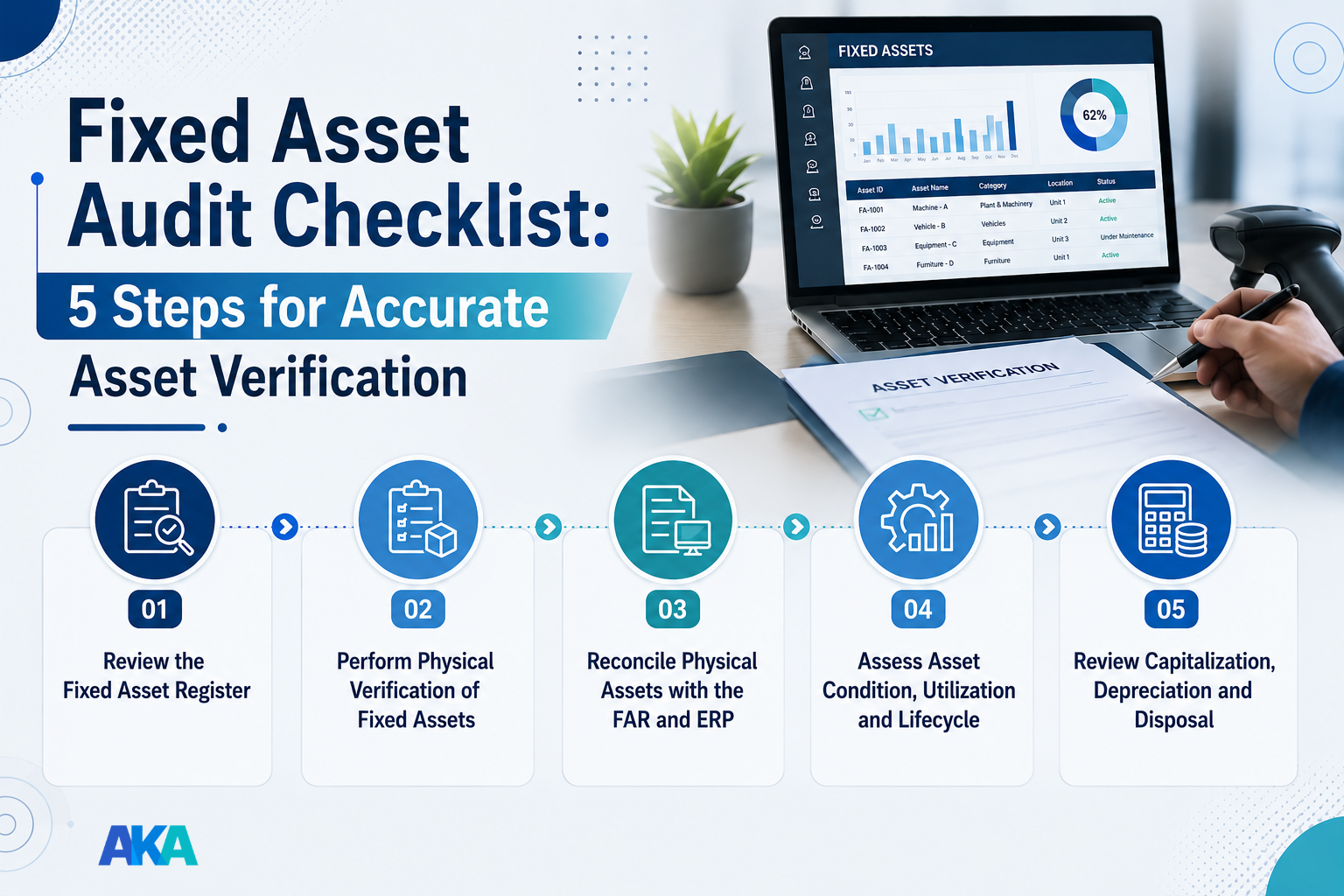
5 Steps to Conduct a Fixed Asset Audit
1. Review the Fixed Asset Register
The Fixed Asset Register audit begins with reviewing the organization's FAR.
Auditors examine asset descriptions, asset IDs, purchase dates, capitalization values, locations, departments, depreciation details and other relevant information.
Recent additions, transfers, disposals and adjustments should be reviewed before physical fixed asset verification begins.
This creates a reliable baseline for comparing accounting records with the organization's physical assets.
2. Perform Physical Verification of Fixed Assets
The next step is to physically verify assets at their recorded locations.
Auditors can verify:
Asset tag or barcode
Serial number
Asset description
Physical location
Department or custodian
Physical condition
Operational status
Any asset that is missing, damaged, untagged, relocated or untraceable should be recorded as an exception.
For large asset bases, barcode scanning, QR codes, RFID and mobile asset verification can improve the speed, coverage and accuracy of physical asset verification.
3. Reconcile Physical Assets with the FAR and ERP
Physical verification is only one part of a fixed asset audit.
The next step is fixed asset reconciliation between:
Physical Asset → Fixed Asset Register → ERP/Accounting Records
This process can identify:
Assets physically present but missing from the FAR
Assets recorded but not physically found
Duplicate asset records
Incorrect asset locations
Incorrect asset descriptions
Assets assigned to the wrong department
Disposed assets still appearing in the register
These exceptions can directly affect financial reporting, depreciation, asset valuation and internal controls.
4. Assess Asset Condition, Utilization and Lifecycle
An asset can exist physically and still represent a management problem.
During fixed asset verification, businesses should identify assets that are:
Fully operational
Underutilized
Idle
Damaged
Obsolete
Beyond economical repair
Awaiting disposal
This adds an important management dimension to a fixed asset audit: understanding how effectively capital is being utilized.
For example, an expensive machine that has remained idle for several months represents tied-up capital even though it is correctly recorded in the FAR.
Audit findings can therefore support decisions around maintenance, replacement, disposal and future capital expenditure.
5. Review Capitalization, Depreciation and Disposal
A complete fixed asset audit should also consider the accounting lifecycle of assets.
Auditors can review whether:
Capital expenditure has been appropriately capitalized
Assets are capitalized from the appropriate date
Depreciation is calculated correctly
Useful lives are appropriately recorded
Capital Work-in-Progress (CWIP) has been reviewed for capitalization
Impairment indicators are identified where relevant
Disposed or scrapped assets have been removed from the FAR
Disposal proceeds and records are properly accounted for
This connects physical asset verification with financial accuracy and asset valuation.
From Asset Counting to Asset Governance
The real value of a fixed asset audit service is not simply finding missing assets. It is understanding why discrepancies occur.
For example, repeated location differences may indicate weak asset transfer controls. Unrecorded disposals may point to gaps in the disposal process. Unidentified assets may indicate weaknesses in capitalization or asset tagging.
A useful asset lifecycle is:
Procurement → Capitalization → Tagging → Physical Verification → Movement → Utilization → Depreciation → Impairment → Disposal
Controls should exist throughout this lifecycle.
This makes a fixed asset audit more than a periodic verification exercise. It becomes a way to strengthen fixed asset management, financial controls and capital governance.
What Should a Fixed Asset Audit Deliver?
A comprehensive fixed asset audit service should provide management with more than a list of missing assets.
Key outputs can include:
Physical fixed asset verification results
FAR-to-physical reconciliation
Missing and unrecorded assets
Duplicate asset records
Location discrepancies
Asset condition and utilization observations
Idle and obsolete asset identification
Depreciation and capitalization observations
Disposal exceptions
Financial impact of significant discrepancies
Recommended corrective actions
These outputs give CFOs and management a clearer view of asset accuracy, financial reporting and capital efficiency.
How Ajay Kumar & Associates (AKA) Supports Fixed Asset Audits
Ajay Kumar & Associates (AKA) provides independent Fixed Asset Audit and Physical Verification Services for organizations seeking stronger control over their asset base.
Our approach covers physical asset verification, barcode-based identification and tagging, Fixed Asset Register reconciliation, location verification, asset condition assessment, capitalization and disposal review, and detailed audit reporting.
We look beyond whether an asset physically exists. Our objective is to determine whether each asset is correctly recorded, appropriately located, properly classified and effectively controlled.
With over 24 years of audit experience, AKA combines audit expertise with technology-enabled verification and structured reporting to help organizations identify missing, duplicate, idle, obsolete and unrecorded assets.
The outcome is greater asset visibility, stronger internal controls, more reliable financial reporting and better-informed decisions around asset utilization, replacement and capital expenditure.
A fixed asset audit should do more than confirm what is on the register. It should help management understand what is owned, what is being utilized, what requires attention, and where capital can be better managed.
That is the foundation of stronger asset governance and more informed capital decisions.