
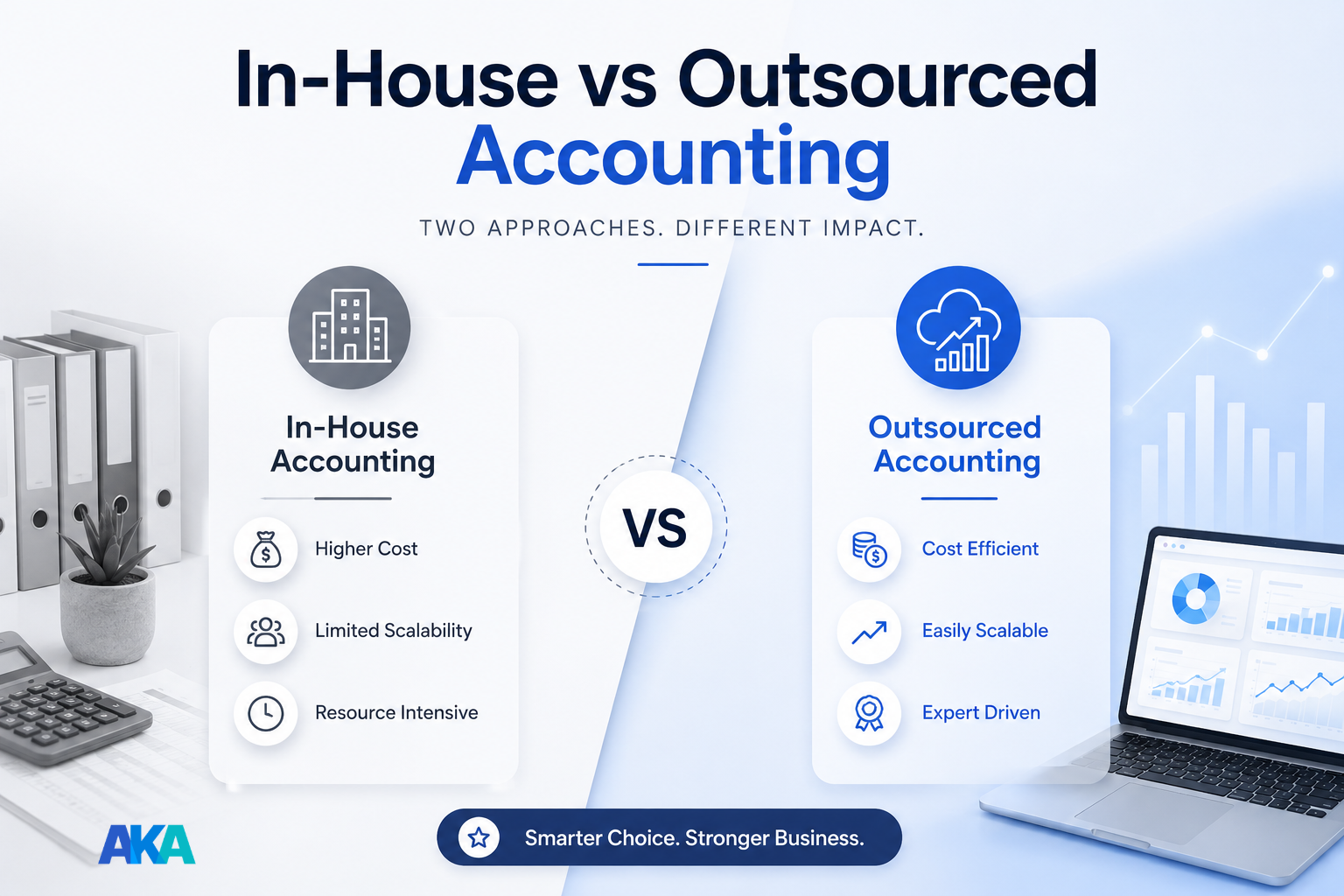
In-House vs Outsourced Accounting: What It Actually Costs
Many business owners assume that hiring an accountant for ₹35,000 per month means their accounting cost is ₹35,000 per month.
In reality, that's only part of the picture.
When you factor in employee benefits, software subscriptions, office
infrastructure, training, and management time, the actual cost of maintaining
an in-house accounting team can be significantly higher. Understanding the true
cost of accounting is essential when deciding between in-house
accounting and outsourced accounting services.
The Hidden Cost of In-House Accounting
Let's consider a typical SME in India.
An accountant with a monthly salary of ₹35,000 may appear affordable
initially. However, businesses must also account for:
·
Provident Fund (PF) contributions
·
Employee State Insurance (ESI)
·
Annual bonuses and incentives
·
Accounting software licenses
·
Computer systems and office space
·
Recruitment and training costs
·
Management and supervision time
Once these expenses are included, the total cost of an in-house accountant
can range from ₹50,000 to ₹65,000 per month, or approximately ₹3.6
lakh to ₹9.5 lakh annually, depending on experience and business
requirements.
How Much Does Outsourced Accounting Cost?
For many SMEs, outsourced bookkeeping and accounting services
cost significantly less.
Depending on transaction volume and service scope, businesses typically
spend between ₹50,000 and ₹2.5 lakh annually on outsourced
accounting support.
This often results in 30% to 60% cost savings compared to
maintaining a full-time in-house accounting function.
However, the biggest advantage is not just lower cost—it's access to
specialized expertise without the overheads associated with hiring and managing
employees.
The Cost of Employee Turnover
One of the most overlooked expenses in accounting operations is staff
turnover.
Many junior accountants in SMEs change jobs every 18 to 24 months. When an
accountant resigns, businesses often experience:
·
Reduced productivity during the notice period
·
Recruitment delays
·
Training and onboarding costs
·
Knowledge transfer issues
·
Increased risk of filing errors and compliance
delays
In many cases, it can take two to three months before a replacement becomes
fully productive.
For businesses handling GST returns, TDS filings, payroll processing, and
monthly reporting, this disruption can create operational and compliance risks.
With outsourced accounting services, continuity is built
into the service model. Accounting firms typically maintain backup resources
and standardized processes, ensuring work continues even when team members
change.
Why Accounting Expertise Matters More Than
Ever
Tax and regulatory compliance continues to evolve, requiring businesses to
stay updated with changing filing requirements and reporting standards.
For an in-house accountant, adapting to regulatory changes often means
additional training while managing day-to-day responsibilities.
An outsourcing partner, however, works across multiple industries and
clients, enabling them to implement updates more efficiently and apply best
practices gained from broader experience.
This reduces compliance risks and helps businesses maintain accuracy in financial
reporting.
In-House Accounting vs Outsourced
Accounting: Which Is Better?
The right choice depends on your business size, transaction volume, and
operational complexity.
In-House Accounting May Be Suitable If:
·
Your business exceeds ₹10–25 crore in annual
turnover
·
You process thousands of transactions each month
·
You require daily on-site financial support
·
You manage complex inventory and operational
workflows
Outsourced Accounting Services May Be Ideal If:
·
You are a startup or growing SME
·
You want to reduce accounting costs
·
You need expert support for GST, TDS, payroll,
and compliance
·
You want scalable accounting services without
increasing headcount
·
You prefer focusing on core business activities
rather than administrative functions
The Hybrid Model: A Growing Trend
Many businesses today adopt a hybrid approach.
This model combines an in-house resource for daily operational activities
with an outsourced accounting firm for:
·
GST compliance
·
TDS filings
·
Financial reporting
·
Payroll management
·
Internal controls
·
Management accounting
The hybrid approach offers the benefits of both accessibility and
specialized expertise while keeping costs under control.
Why Businesses Choose Ajaykumar &
Associates (AKA)
At Ajaykumar & Associates (AKA), we help businesses evaluate whether an
in-house, outsourced, or hybrid accounting model best suits their operational
and financial needs.
Our team provides:
·
Outsourced Accounting Services
·
Bookkeeping Services
·
GST Compliance Support
·
Payroll Processing
·
Financial Reporting
·
Internal Audit Services
·
Management Accounting Solutions
We work closely with startups, SMEs, and growing businesses to improve
financial efficiency, reduce compliance risks, and create scalable accounting
processes.
When comparing in-house vs outsourced accounting, the
decision should not be based solely on salary costs.
Businesses must consider the complete cost of hiring, infrastructure,
turnover, compliance management, and operational risk.
For many SMEs, outsourced accounting offers significant cost savings, access
to specialized expertise, and greater business continuity.
If you're evaluating your current accounting costs or considering accounting
outsourcing services, Ajaykumar & Associates can help you assess the most
cost-effective solution for your business.